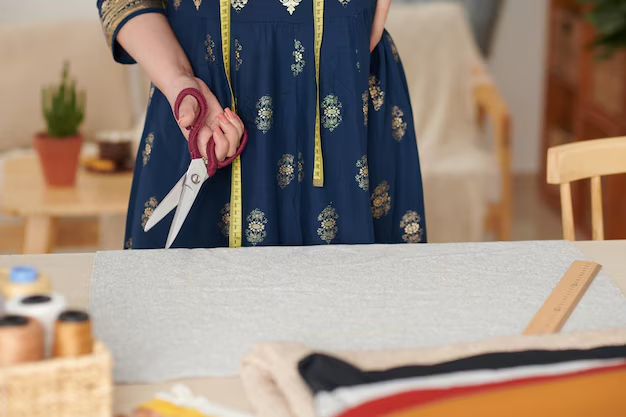
How To Make Mattress Cover At Home: Step‑by‑Step FAQ Guide
If you’re searching for “How To Make Mattress Cover At Home”, you’re likely looking for a simple, budget‑friendly way to protect your mattress or refresh its look. This guide walks through materials, measurements, and basic sewing steps in an easy FAQ format so you can confidently create a cover that fits and stays in place.
What does it mean to make a mattress cover at home?
Making a mattress cover at home usually means sewing a fitted-style fabric cover that slips over your mattress, similar to a fitted sheet, or creating a zippered encasement that completely surrounds it.
A DIY mattress cover typically:
- Protects the mattress surface from dust and everyday wear
- Improves comfort slightly, depending on the fabric chosen
- Refreshes appearance if the mattress looks worn or stained
It doesn’t usually replace a specialized waterproof or protective encasement, but it can add an extra, washable layer between you and the mattress.
What materials do I need to make a mattress cover?
For most basic home projects, you need:
- Fabric: Cotton, cotton blend, bamboo blend, or another breathable woven fabric
- Elastic: For corners and edges (for a fitted style)
- Thread: All-purpose matching thread
- Measuring tools: Tape measure, fabric chalk or pencil
- Cutting tools: Fabric scissors or rotary cutter
- Sewing machine (or hand-sewing supplies, if you’re patient)
Optional additions:
- Zipper: For a full encasement style
- Lining layer: For extra thickness or a slightly smoother feel
- Reinforcement tape or bias tape: To strengthen seams
How do I measure my mattress correctly?
Getting the measurements right is the most important step when figuring out How To Make Mattress Cover At Home.
Measure:
- Length: From head to foot, along the top surface.
- Width: From side to side, along the top surface.
- Depth (height): From bottom edge to the very top of the mattress, including any pillow top.
Then add allowances:
- For a fitted-style cover:
- Add the mattress depth plus 3–4 cm (about 1–2 inches) on each side for tucking and seams.
- For a zippered encasement:
- Plan for top panel, bottom panel, and side strip equal to the perimeter of the mattress plus seam allowances.
Write down the final cut sizes before you start cutting fabric.
What is the simplest way to make a fitted mattress cover?
For many people, the easiest version of How To Make Mattress Cover At Home is a fitted-sheet style cover.
Basic step-by-step
Cut the top panel
- Size: mattress length × mattress width, plus 2× mattress depth + seam allowance on each dimension.
- Example: For a 190 × 135 cm mattress that is 25 cm deep, you might cut roughly 240 × 185 cm, depending on your seam allowances.
Mark and cut the corners
- At each corner, cut out a square equal to the mattress depth + 2–3 cm for seams.
- This creates flaps that will form the sides.
Sew the corner seams
- Fold each cut-out corner right sides together and sew along the edge to form a pocket.
- Finish raw edges with a zigzag or overlock stitch if possible.
Create a casing for elastic
- Fold the entire bottom edge under 1–2 cm, then fold again and stitch, leaving a small opening to insert elastic.
Add elastic
- Insert elastic through the casing (either around the full perimeter or only at corners).
- Adjust tension so the cover grips the mattress without straining the fabric.
- Sew the elastic ends together and close the opening.
You now have a simple fitted cover that can be removed and washed.
How do I make a full zippered mattress encasement?
A zippered cover surrounds the mattress on all sides and can be helpful if you want a tighter, more protective layer.
Basic structure
- Top panel: Same size as mattress length × width, plus seam allowances
- Bottom panel: Same size as top
- Side strip: Long strip equal to the perimeter (2 × length + 2 × width), and as wide as the mattress depth + seam allowance
Key steps
- Sew the side strip into a loop matching the mattress perimeter.
- Attach the loop to the top panel right sides together, sewing all around.
- Attach one long side of the zipper to part of the side strip, and the other side to the bottom panel, or install the zipper along one long side and part of two short sides.
- Sew the remaining edges of the bottom panel to the side strip.
- Turn right side out and test the fit on the mattress.
This version demands more measuring and sewing accuracy but creates a secure encasement.
What fabric works best for a DIY mattress cover?
When considering How To Make Mattress Cover At Home, fabric choice affects comfort and durability.
Common options:
- Cotton or cotton blends: Soft, breathable, easy to wash
- Tightly woven fabrics: Offer a smoother barrier against dust and lint
- Stretch knits: Better fit and flexibility, but can be trickier to sew
- Heavier fabrics: May feel more durable but can be warmer and harder to handle
For most home projects, medium-weight woven cotton is a balanced choice between ease of sewing, comfort, and care.
Is a homemade mattress cover the same as a waterproof or protective encasement?
No. A standard DIY fabric cover:
- Provides a washable layer between you and the mattress
- Reduces direct wear on the mattress fabric
- Helps keep dust and small particles from reaching the mattress surface
However, unless you use specialized waterproof or barrier fabrics and construction methods, a homemade cover will not typically offer the same level of moisture or allergen protection as dedicated products.
How should I care for a DIY mattress cover?
To keep your cover fresh:
- Wash regularly according to the fabric’s care instructions
- Avoid harsh bleach unless the fabric clearly tolerates it
- Tumble dry on low or line dry to reduce shrinkage and wear
- Check seams and elastic occasionally and reinforce if needed
Proper care helps your cover last longer and keeps your mattress cleaner.
✅ Quick Mattress Takeaways
Key points consumers should understand about How To Make Mattress Cover At Home
- Accurate measuring is essential: Length, width, and depth plus seam and tuck allowances ensure a snug fit.
- Two main styles: A fitted-style cover is simpler; a zippered encasement offers fuller coverage but is more complex to sew.
- Choose breathable, washable fabric: Medium-weight cotton or blends are widely used for comfort and ease of care.
- Elastic makes fitting easier: A perimeter or corner elastic casing helps the cover stay in place.
- DIY covers are mainly for cleanliness and wear: They add a washable layer but are not automatically waterproof or highly protective without specialized materials.
- Regular washing and inspection: Keeps the cover hygienic and extends both the cover’s and mattress’s usable life.
By understanding How To Make Mattress Cover At Home and following simple measuring and sewing steps, you can create a practical, washable layer that helps keep your mattress cleaner and more comfortable over time.