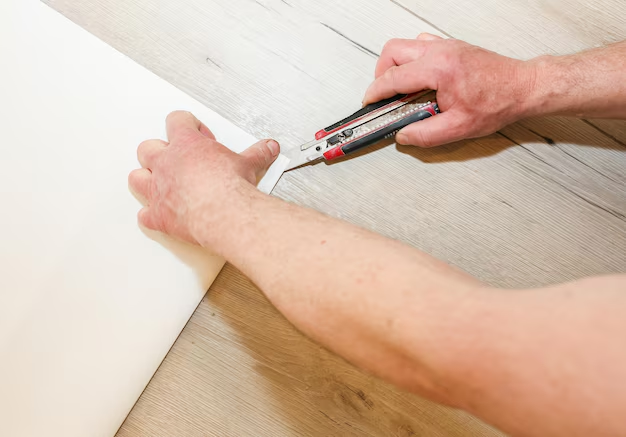
How To Cut Mattress In Half: What To Know Before You Start
If you’re searching for “How To Cut Mattress In Half”, you’re likely trying to make an old mattress easier to move, repurpose it, or fit it into a smaller space. While it is possible to cut many mattresses, it’s not always simple—or safe—without some planning.
This FAQ-style guide explains when it’s realistic, how different mattress types behave, and what safety and practical issues to consider before you cut.
Is it actually possible to cut a mattress in half?
In many cases, yes—but it depends heavily on the mattress type and your goal.
- Foam mattresses (memory foam, polyurethane foam, latex) are usually the easiest to cut cleanly.
- Traditional innerspring mattresses can be cut, but you’ll be dealing with metal coils and sharp edges.
- Hybrid mattresses contain both coils and foam, making them more complex to modify.
- Mattresses with integrated borders, zippers, or encased edges may lose stability and shape once cut.
Before deciding how to cut mattress in half, check:
- Whether it has springs or only foam
- If there are any internal wires, air chambers, or special support zones
- The thickness, as very thick mattresses are harder to handle once cut
In nearly all cases, cutting a mattress voids its warranty and permanently changes how it feels and supports weight.
Why would someone want to cut a mattress in half?
People usually look up how to cut mattress in half for one of these reasons:
- To make disposal or transport easier in tight stairwells or doorways
- To create two smaller sleeping surfaces (for campers, RVs, or guest spaces)
- To reuse foam as cushions, pet beds, or DIY projects
It’s important to understand that a cut mattress rarely performs like a factory-made smaller mattress. Support can be uneven, edges may sag, and the cover will no longer be fully intact.
What should I consider before cutting a mattress?
Think through these points carefully:
- Safety: You’ll be cutting dense material and possibly metal. There’s risk of cuts, flying fragments, and breathing in dust or fibers.
- Durability: The new halves may tear, crumble, or lose shape faster, especially along the cut edge.
- Comfort: One half may feel firmer or softer than the other depending on how internal layers are arranged.
- Use case: Using a cut half for occasional guests or camping is different from relying on it for daily sleep.
If your goal is a long-term primary bed, altering a mattress is usually not ideal.
How do I safely cut a foam mattress in half?
For an all-foam mattress, the basic approach is more straightforward than for innerspring or hybrid designs. A common method (simplified) looks like this:
Remove bedding and inspect the construction
Unzip or carefully open the cover if it’s removable. Identify any glued seams or embedded materials.Mark a straight cutting line
Use a tape measure and a marker to draw a clear line down the center. A straight line helps both halves feel more even.Use an appropriate cutting tool
Many people use a long, sharp knife or a serrated blade. Some prefer an electric knife for a smoother cut.- Work slowly to avoid jagged edges.
- Cut in shallow passes rather than trying to slice through in one motion.
Trim and tidy the edges
After the main cut, small uneven areas can be trimmed so the edge is smoother and less likely to crumble.Address the cover
The original cover will no longer fully enclose both halves. Some people:- Wrap each half in a fitted sheet, or
- Use a separate fabric cover for each part.
Throughout the process, keep your hands away from the blade path and cut on a stable surface.
What about cutting an innerspring or hybrid mattress?
Cutting innerspring or hybrid models is more complicated:
- Metal coils or wires: You’ll need tools capable of cutting metal (like wire cutters), and cut edges can be sharp.
- Potential for loose springs: Coils may spring out or shift once tension is released.
- Uneven support: Springs are often arranged to support the full original width; cutting changes how weight is distributed.
If you still intend to cut this type:
- Expect to work through fabric, padding, and then the metal layer.
- Plan a way to cover and blunt any sharp metal ends so they don’t damage bedding or cause injury.
- Understand that each half may be less stable, especially near the new edge.
Because of these factors, some people choose to remove and discard the spring unit entirely and only keep the foam or padding layers for reuse.
Is it safe to sleep on a mattress that’s been cut in half?
Safety depends on:
- Exposed materials: Some internal layers are meant to be enclosed. Leaving them exposed can lead to loose fibers, dust, or contact with components that were not designed for skin contact.
- Sharp edges: Any exposed metal, plastic frames, or hardware must be carefully covered.
- Structural integrity: A mattress that bends, sags, or collapses at the cut edge may not feel stable or comfortable.
For occasional or temporary use, many people find a carefully cut foam half acceptable. For everyday long-term use, a purpose-made mattress of the correct size is usually more predictable in comfort and durability.
✔️ Quick Mattress Takeaways
Key points consumers should understand about How To Cut Mattress In Half
- Foam is easiest: All-foam mattresses are the most suitable candidates for cutting in half.
- Springs complicate things: Innerspring and hybrid mattresses contain metal that’s harder and riskier to cut.
- Expect changed comfort: A cut mattress will not feel exactly like a factory-made smaller mattress.
- Covers matter: Once cut, the original cover won’t fully protect or contain both halves.
- Safety first: Watch for sharp edges, loose fibers, and unstable structure, especially if children or pets use the space.
- Think about purpose: Occasional, utility use (camping, guest, projects) is more realistic than turning halves into permanent everyday beds.
Understanding how to cut mattress in half helps you weigh the effort, safety considerations, and likely results. With careful planning—especially for foam models—you can repurpose a mattress more effectively, while recognizing the limits of what a modified mattress can reasonably do.