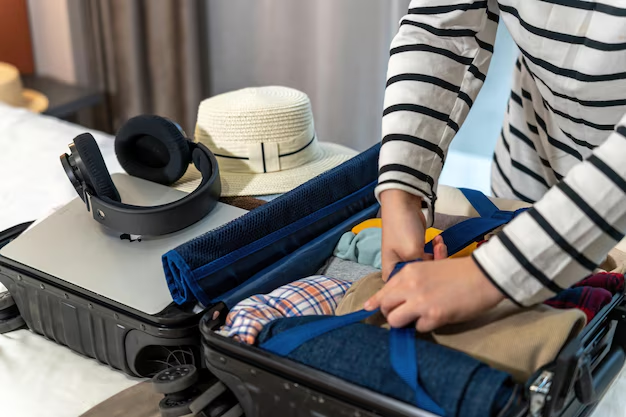
Can I Bring an Air Mattress on a Plane? Practical FAQ for Travelers
Wondering “Can I bring an air mattress on a plane?” If you rely on an air mattress for comfort when you travel, it makes sense to want to pack it. The good news: in many situations you can fly with an air mattress—but there are specific rules and practical details to understand before you head to the airport.
This FAQ-style guide walks through what is usually allowed, how to pack your air mattress, and what to consider for a smoother trip.
Can I Bring an Air Mattress on a Plane at All?
In most cases, you can bring an air mattress on a plane as either:
- Checked baggage, or
- Carry-on baggage, if it fits your airline’s size and weight rules
Air mattresses are typically treated like any other piece of soft luggage or equipment. The main restrictions usually come from:
- Size and weight limits for carry-on and checked bags
- Included components, such as an electric or battery-powered pump
The mattress itself, when deflated and folded, is generally not an issue from a security standpoint.
Should I Pack My Air Mattress in Carry-On or Checked Luggage?
Carry-on baggage
You may be able to bring a compact, single-size air mattress in your carry-on if:
- It fits within your airline’s carry-on dimensions
- It does not push your baggage over any weight limit
- It is folded neatly and packed in a bag or case
Pros of carry-on:
- Less risk of damage or loss
- You keep control of it throughout your journey
Cons:
- Takes up valuable space in your cabin bag
- May be questioned if it looks bulky or unclear on X-ray
Checked baggage
Larger or heavier air mattresses are usually better in checked bags:
- They can be folded into a suitcase or duffel
- Weight is easier to distribute between bags
- You are less restricted by size than with carry-on
Important: Extra-heavy bags may incur fees, so it helps to know the weight of your air mattress before packing.
What About the Air Pump? Is That Allowed on Planes?
Most questions about “Can I bring an air mattress on a plane?” are really about the pump, not the mattress.
Electric pumps
- Corded electric pumps (plug-in style) are usually allowed in both carry-on and checked bags, as long as they have no fuel or restricted components.
- They may be inspected more closely by security due to wiring and motors.
Battery-powered pumps
- Removable batteries (especially loose lithium batteries) often have stricter cabin rules.
- In many cases, loose lithium batteries must go in carry-on, not checked baggage.
- If batteries are built into the pump, they may have specific airline restrictions depending on size and type.
Manual pumps
- Hand or foot pumps are usually the simplest option.
- They contain no electronics and are generally easy to bring in either carry-on or checked baggage.
If you’re unsure about a specific pump design, packing it in your carry-on and being ready to show it during screening can make security checks smoother.
Can I Use an Air Mattress During the Flight?
Even if you can bring it on board, using an air mattress during the flight is usually not allowed or practical. Reasons include:
- Limited floor and seating space in most cabins
- Safety rules requiring aisles and exit paths to be clear
- Seatbelt requirements during takeoff, landing, and turbulence
An air mattress is primarily for use at your destination—in a hotel, guest room, rental, or campsite—not as an in-flight sleeping surface.
How Should I Pack an Air Mattress for Air Travel?
To keep your mattress safe and your luggage organized, consider:
- Fully deflate it to remove all air
- Fold it tightly according to the manufacturer’s guidelines
- Use a storage bag (cloth or plastic) to keep it separate from other items
- Protect it from sharp objects by placing it in the middle of your suitcase, cushioned by soft items
- Avoid overstuffing your bag so seams on the mattress are not strained
A compact, well-packed mattress is less likely to be damaged and more likely to fit easily within airline rules.
Will My Air Mattress Be Damaged by Flying?
The cabin or cargo hold pressure on commercial flights is typically controlled and should not damage a well-made, deflated air mattress.
Key points:
- Do not pack it partially inflated; always remove as much air as possible.
- Extreme temperature changes are more likely to affect small items like electronics or liquids than a folded piece of vinyl or fabric.
Most travelers find that an air mattress handled carefully and fully deflated arrives in similar condition to any other packed bedding.
✅ Quick Mattress Takeaways
Key points consumers should understand about “Can I Bring An Air Mattress On a Plane”
- Yes, you can usually bring an air mattress on a plane, either as carry-on or checked baggage, if it meets your airline’s size and weight rules.
- The deflated mattress itself is rarely the problem; pumps and batteries are more likely to have specific restrictions.
- Electric and battery pumps may face extra rules, especially if lithium batteries are involved; manual pumps are usually simplest.
- Using an air mattress during the flight is generally not allowed due to space and safety requirements—it is mainly for use at your destination.
- Pack the mattress fully deflated, neatly folded, and protected from sharp objects to reduce the risk of punctures or seam damage.
- Check your airline’s baggage policies in advance if your air mattress is large, heavy, or includes electronic components.
For travelers who value familiar sleep setups, bringing an air mattress can be a workable option. Understanding the basic airline and security expectations around size, pumps, and packing helps ensure your mattress—and your trip—arrive as planned.