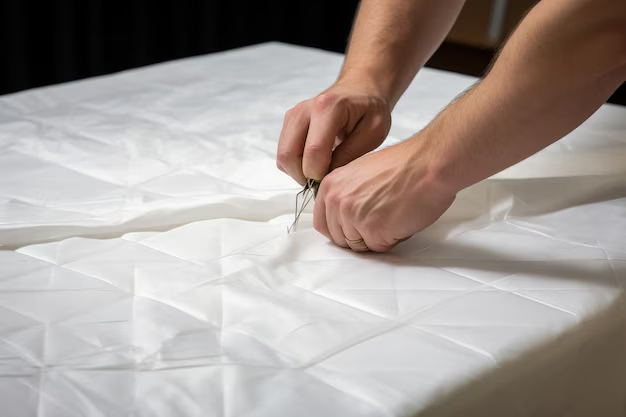
How Latex Mattress Is Made: From Tree Sap to Finished Bed
If you’re searching for “How Latex Mattress Is Made”, you’re likely trying to understand what’s inside the bed, how natural it really is, and what the production process involves. This FAQ-style guide walks through each stage, from raw latex to the finished mattress, in clear, practical language.
What exactly is a latex mattress?
A latex mattress is a bed whose main support and comfort layers are made from latex foam instead of springs or traditional polyurethane foam.
Latex foam used in mattresses usually comes in three main forms:
- Natural latex – derived from rubber tree sap
- Blended latex – a mix of natural and synthetic latex
- Synthetic latex – made from man‑made rubber materials
Understanding how latex mattress is made starts with knowing which type of latex is used, since the process and feel can differ slightly.
How is natural latex collected for mattresses?
Where does the latex come from?
Natural latex starts as a milky fluid tapped from rubber trees. These trees are usually grown in warm, humid regions.
How is the sap harvested?
- A small cut is made in the bark of the tree.
- The sap slowly drips into a collection cup.
- Workers gather the filled cups and combine the sap.
The latex sap is then filtered to remove debris and may be stabilized with small amounts of additives so it does not spoil before foaming.
What are the main methods used to make latex foam?
When people ask how latex mattress is made, they often mean how the liquid sap turns into solid foam. There are two widely used methods:
1. Dunlop process
The Dunlop method is one of the oldest and most common ways to make latex foam:
- The liquid latex is whipped into a froth.
- It’s poured into a mold of the desired size.
- The mold is closed and heated (vulcanized), causing the latex to set.
- The foam block is removed, washed, and dried.
Dunlop foam often feels slightly denser and more supportive, especially toward the bottom, because heavier particles can settle a bit during production.
2. Talalay process
The Talalay method adds a few extra steps:
- Latex is whipped into a foam and partially fills a mold.
- The mold is sealed and air is removed, expanding the foam evenly.
- The latex is flash-frozen, then heated to set it.
- The foam is removed, washed, and dried.
Talalay foam tends to feel more uniform and buoyant, with a somewhat lighter, more airy structure compared with typical Dunlop.
Both methods can use natural, blended, or synthetic latex, and both can be made in different firmness levels.
What happens after the latex foam is made?
Once the foam blocks are ready, several finishing steps prepare them for use in a mattress.
Cutting and shaping
- Large foam blocks are cut into layers of specific thicknesses.
- Different layers can have different firmness levels to create a balanced feel.
Ventilation holes
Many latex layers are produced or drilled with pinholes or channels. These are designed to:
- Help air move through the mattress
- Slightly adjust the firmness and contouring
Washing and drying
Latex foam is typically washed multiple times and thoroughly dried. This helps remove excess soaps, residues, and some proteins from the manufacturing process.
How is a full latex mattress assembled?
Layering the core
To build a mattress, manufacturers usually stack multiple latex layers, for example:
- A firmer base layer for overall support
- One or more medium layers for transition and pressure distribution
- A softer top layer for initial comfort
These layers may be glued, encased in a fabric sleeve, or held in place by the outer cover.
Adding the mattress cover
The latex core is then placed inside a fabric cover, often made from materials like:
- Knit or woven textiles
- Quilted fabric with fiber fill or thin foam
- Sometimes natural fibers like cotton or wool blends
The cover is usually zippered or sewn shut around the latex core. At this point, the product is recognizably a finished latex mattress.
Is making a latex mattress different for hybrids?
Yes. When exploring how latex mattress is made, it helps to know that some mattresses combine latex with other materials.
A latex hybrid typically includes:
- A coil system (pocketed springs) as the support core
- One or more latex layers on top for comfort
- A fabric cover that surrounds both the coils and the latex
In this case, the latex layers are manufactured the same way, but they’re stacked over springs instead of forming the entire mattress core.
Are all latex mattresses fully natural?
Not always. The phrase “latex mattress” can refer to:
- All‑natural latex mattresses (using mostly tree-derived latex)
- Blended latex mattresses (mix of natural and synthetic)
- Synthetic latex mattresses (fully man‑made latex)
The basic steps of foaming, molding, curing, washing, and cutting are similar, but the raw materials differ. If the source of the latex matters to you, it’s helpful to check whether a mattress uses natural, blended, or synthetic latex.
✔️ Quick Mattress Takeaways
Key points consumers should understand about how latex mattress is made
- Starts as sap or synthetic liquid: Natural latex comes from rubber tree sap; synthetic latex is made from man‑made rubber.
- Foam is created by whipping and molding: Latex is whipped into foam, poured into molds, heated, washed, and dried.
- Two main processes:
- Dunlop – poured, baked, denser feel
- Talalay – vacuum-expanded, frozen, more uniform feel
- Layers build the mattress: Multiple latex layers of different firmness levels create support and comfort.
- Covers complete the build: A fabric cover encases the latex core, sometimes with quilting or added fibers.
- Hybrids add coils: Latex can be paired with springs, but the latex itself is made through the same foaming processes.
- “Latex” doesn’t always mean natural: Mattresses may use natural, blended, or synthetic latex, even if they are all labeled as latex.
Understanding how latex mattress is made helps you make sense of terms like Dunlop, Talalay, natural, and hybrid, and gives you a clearer picture of what you’re actually sleeping on.