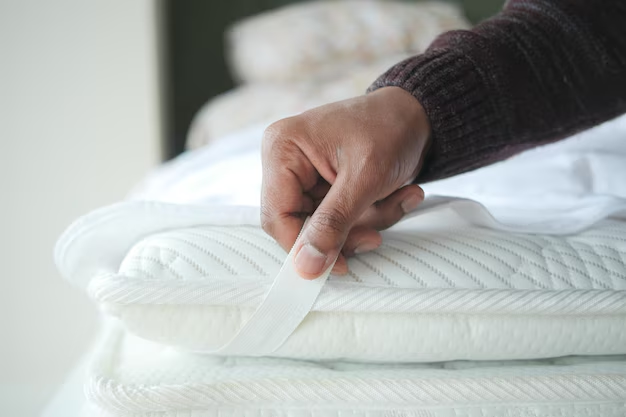
Does Innerspring Mattress Need Box Spring? How to Choose the Right Support
If you’re asking “Does innerspring mattress need box spring?”, you’re usually trying to figure out whether your new or existing innerspring bed really requires a box spring, or if a platform, slats, or even the floor will work just as well. This guide walks through the most common questions so you can choose a support system that keeps your mattress comfortable and within warranty.
What Is a Box Spring and How Is It Different from Other Bases?
A box spring is a supportive foundation that typically includes a wooden or metal frame with springs or metal rods inside, covered in fabric. It was originally designed to work with traditional innerspring mattresses, helping to:
- Absorb shock and movement
- Add height to the bed
- Provide a flat, stable surface
Today, many foundations that look like box springs are actually solid or slatted platforms without springs. These are sometimes called “foundations” rather than true box springs.
Other common base types include:
- Platform beds – Solid or closely spaced slats; usually no need for a box spring
- Adjustable bases – Motorized frames that raise or lower the head and/or foot
- Slatted frames – Wooden or metal slats that may or may not need additional support
Does Innerspring Mattress Need Box Spring in Most Cases?
For modern innerspring mattresses, the answer is often: not strictly, but you do need proper support.
Many innerspring models work well on:
- A solid platform
- Closely spaced slats
- A non-flexing foundation (sometimes called a “flat box spring”)
However, some manufacturers still recommend or require a matching box spring or foundation to:
- Provide the intended feel and support
- Avoid sagging or uneven wear
- Keep the warranty valid
Because of this, the most accurate answer to “Does innerspring mattress need box spring?” is:
How Do I Know If My Innerspring Mattress Needs a Box Spring?
1. Check the warranty and care guidelines
Most mattress warranties specify what counts as an acceptable support system. Look for details like:
- Whether a box spring or foundation is required
- Minimum slat spacing (for example, slats often need to be close together)
- Center support requirements for larger sizes
If the warranty states that a “rigid, non-flexing foundation” is required, a platform or solid foundation may be fine, even if it does not contain springs.
2. Consider the bed frame you already have
Your existing frame affects whether you need a box spring:
- Metal rail frame with no slats – Usually needs a box spring or foundation
- Platform bed with solid deck or tight slats – Often does not need a box spring
- Older, flexible slat frames – May not give enough support alone
3. Think about the feel you prefer
A box spring can add a slightly bouncier, softer feel, while a solid platform tends to feel firmer and more stable. Neither is “better” for everyone; it comes down to comfort preference within the manufacturer’s guidelines.
What Happens If I Use the Wrong Support?
Using an innerspring mattress on an unsuitable base can lead to:
- Premature sagging or impressions
- Uneven support or a “hammocking” feel
- Noise from a weak frame or loose slats
- Possible warranty issues if the mattress is damaged
To avoid this, make sure your support system is:
- Flat and level
- Sturdy, with minimal flexing
- Able to hold the combined weight of the mattress and sleepers
Box Spring vs Other Bases for Innerspring Mattresses
Here is a quick comparison to help you decide:
| Base Type | Works with Innerspring?* | Typical Feel/Notes |
|---|---|---|
| Traditional box spring | Often, if manufacturer allows | Adds height and bounce; some flex |
| Rigid foundation | Commonly compatible | Firm, stable surface; no springs inside |
| Platform bed | Often compatible | No extra box spring needed if slats are close and strong |
| Slatted frame only | Sometimes, if slats are close | May need added support or bunkie board |
| Floor | Usually strong but low airflow | Very firm, low height; may not meet warranty terms |
*Always check your specific mattress guidelines.
When Is a Box Spring Especially Helpful?
A box spring or similar foundation can be especially useful if:
- Your frame is just metal rails with no built-in support
- You prefer a taller bed height
- You want a bit of extra cushioning and bounce under the mattress
- Your warranty clearly requires a box spring or approved foundation
If you already have a high, solid platform bed, adding a box spring may make the bed uncomfortably tall and is often unnecessary.
✅ Quick Mattress Takeaways
Key points consumers should understand about “Does Innerspring Mattress Need Box Spring”:
- Not always required: Many innerspring mattresses work on platforms, slats, or rigid foundations instead of traditional box springs.
- Warranty rules matter: The best way to know is to check the warranty and care instructions for your specific mattress.
- Support is the real priority: Whatever you use should be flat, sturdy, and properly supported in the center for larger sizes.
- Your frame may decide for you: Simple metal rail frames usually need a box spring or foundation; solid platforms typically do not.
- Feel can change by base: Box springs can add bounce and softness, while platforms and rigid foundations usually feel firmer and more stable.
If you keep these points in mind, you can confidently answer “Does innerspring mattress need box spring?” for your own setup, choosing the base that supports both your mattress and your comfort over the long term.