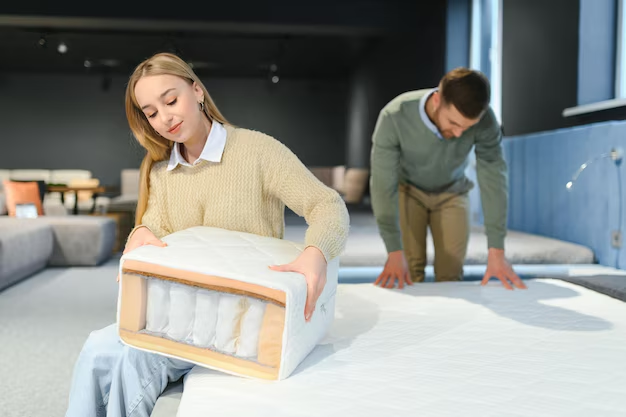
How To Buy Mattress: A Simple, Practical FAQ Guide
If you’re searching for “How To Buy Mattress”, you’re likely overwhelmed by choices and unsure where to start. This FAQ-style guide walks through the key decisions step by step so you can choose a mattress that fits your body, space, and budget with more confidence.
What does “How To Buy Mattress” really involve?
When people look up how to buy mattress, they’re usually trying to answer:
- What size and type do I need?
- How firm should it be?
- What’s a reasonable budget?
- How do I compare options in-store and online?
Buying a mattress means balancing comfort, support, durability, and price. There is no single “best” mattress; the right one depends on how you sleep, who you share the bed with, and what feels comfortable to you.
Which mattress size should I choose?
How do I pick the right mattress size?
Think about:
- Your height and body size
- Whether you share the bed
- Room size and layout
As a quick guide:
- Twin / Twin XL – Suitable for single sleepers and smaller rooms
- Full – More space for a single adult
- Queen – Common choice for couples or those who like extra room
- King / Larger – Best if you share the bed and want plenty of personal space
Measure your room and leave enough walking space around the bed so it doesn’t dominate the room.
What mattress type is right for me?
What are the main mattress types?
Most mattresses fall into a few broad categories:
Innerspring: Uses coils with a comfort layer on top.
- Often feels bouncier with more airflow.
Memory foam: Uses foam that contours around the body.
- Many sleepers like the “hugging” feel and motion isolation.
Hybrid: Combines coils with foam or other comfort layers.
- Aimed at blending support, bounce, and contouring.
Latex: Uses latex foam (natural, synthetic, or blended).
- Often has a springy, responsive feel.
How do I choose between them?
Focus on how you want the mattress to feel:
- Prefer a bouncy, traditional feel? Innerspring or certain hybrids may suit you.
- Like a contouring, “pressure-relief” feel? Memory foam or foam-heavy hybrids are options.
- Want a responsive, slightly springy surface? Latex or some hybrids can work well.
How firm should my mattress be?
What does firmness actually mean?
Firmness is how hard or soft the surface feels when you lie on it, often described as:
- Soft
- Medium-soft
- Medium
- Medium-firm
- Firm
There’s no universal standard, but medium to medium-firm feels comfortable for many people.
How does sleeping position affect firmness choice?
- Side sleepers often prefer a slightly softer surface that cushions the shoulders and hips.
- Back sleepers usually do well on medium to medium-firm for balanced support.
- Stomach sleepers often choose firmer options to help keep the body from sinking too deeply.
Use these as general tendencies, then rely on your own comfort during testing or trial periods.
What budget should I set when learning how to buy mattress?
How much does a good mattress cost?
Mattress prices vary widely based on materials, size, and construction. You can find options at lower price points and very high-end designs. A helpful approach is:
- Decide what you are comfortable spending before you shop.
- Compare materials, build quality, and policies (trial, return options, warranty) within that range.
A higher price does not automatically mean a better mattress for you, but extremely low prices can sometimes reflect simpler construction or fewer comfort layers.
What should I look for when testing a mattress?
How do I test a mattress in-store?
When you can lie on a mattress:
- Try your usual sleep position (side, back, stomach) for several minutes.
- Notice pressure points: does anything feel sore, pinched, or overly compressed?
- Roll over and sit near the edge to check ease of movement and edge support.
- If you share the bed, test it together for space and motion transfer.
Move beyond the quick “press with your hand” test; your body weight tells a more accurate story.
How do I evaluate a mattress online?
When buying online, focus on:
- Clear descriptions of firmness and feel
- Layer breakdown (what’s inside the mattress and how thick each layer is)
- Trial period details and what happens if it doesn’t work out
- Warranty terms and what they typically cover (such as certain types of defects)
What about trials, returns, and warranties?
Why do these policies matter in how to buy mattress?
Even when you follow every tip on how to buy mattress, you won’t know exactly how it feels over time until you sleep on it.
Key points to check:
- Trial period: How long can you sleep on it at home before deciding to keep it?
- Return process: Are returns allowed, and are there any fees or conditions?
- Warranty: How long is it, and what kinds of issues are included or excluded?
These details help reduce the risk of choosing something that ends up not working for you.
✔️ Quick Mattress Takeaways
Key points consumers should understand about How To Buy Mattress
- Start with size: Match mattress size to your body, sleeping partner, and room dimensions.
- Choose a type by feel: Innerspring (bouncy), memory foam (contouring), hybrid (mixed), latex (responsive).
- Match firmness to position: Side = a bit softer; back = medium to medium-firm; stomach = firmer (as a general guide).
- Set a realistic budget: Look for solid materials and sensible construction at a price you’re comfortable with.
- Test thoughtfully: Lie in your real sleep positions, check for comfort and support, and notice movement and edge feel.
- Read the fine print: Trial periods, return options, and warranties are important parts of buying a mattress safely.
Understanding how to buy mattress is mainly about knowing your own needs and knowing what to look for: size, type, firmness, quality, and policies. With these basics in mind, you can compare options more calmly and choose a mattress that supports comfortable, consistent sleep over the long term.